Saturday, March 31, 2012

No. 20: Savings, association, and health come to the fore because of yen’s depreciation (April 1, 2012)

Market trend
Japanese yen recovered the level of 80 yen per U.S. dollar in mid-February, and the closing value of the Nikkei Stock Average also recovered the level of 10,000 yen in mid-March. However, the low yen means higher gasoline price. The price of regular gasoline stood at 157.6 yen per liter today, recording the highest price in the past three and a half year. An increasing number of drivers buy gasoline for a fixed value instead of filling up the tank. Another changes in consumer behavior are foreseen.

The unstable political world still makes consumers worry about the economic prospect, and it will supposedly take time to improve the thrifty attitudes of Japanese consumers. But sales of ecology-related products and products to support the recovery of the disaster-stricken areas will go up steadily. LED light fittings and renewable energy systems like residential solar panels will maintain the sales with the background of growing awareness of energy saving.

The March 11 disaster of last year made the association between Japanese even stronger. Many thanks, Facebook! The efforts of devastated prefectures to market their commercial and agricultural products of local specialty will continue to stimulate domestic consumption. On the rebound of satiation, the health conscious trend will grow stronger as shown by the rampant TV commercials of health-care equipment and growing sales of fermented foods. As is often the case, the pendulum swings from side to side.   

An increasing number of convenience stores employ LED lighting for in-store illuminations.


The solar panel market for housing is growing fast with the background of the energy-saving attitudes among consumers. 

Monday, March 19, 2012

No. 19: A new idea on how to make the best use of a railway station (March 19, 2012)

Business trend
JR (Japan Railways) East will launch a new project to support farmers along its railway lines coming April. It will open a direct sales store in a station on its lines in the metropolitan area alternately through the year to sell the signature agricultural products and traditional artifacts of each rural area. Besides helping the direct sales stores achieve good results, the company will give advice to local farmers on what products are selling fast in the metropolitan area for joint development of specialty products in each rural area, and will take care of transport and delivery of products sold.

To be more specific, JR East’s employees who majored in agriculture in college will be the consultants for local farmers. They will give information on fast-selling vegetables and fruits and how to market them more efficiently and effectively in the metropolitan area. The company previously operated this kind of direct sales store irregularly, but it decided to open it on a regular basis to make up for the loss caused by decreasing number of passengers. The company gets a certain rate of profit margin on sales.

Peter Drucker said, “Business is to create and keep a customer.” Likewise, the great Ichizo Kobayashi, founder of Hankyu Railway, said, “If you are in short supply of customers, why don’t you create new customers?” It is not too much to say that the great lesson Kobayashi left to Japanese enabled the Japanese railway business to make such a remarkable progress.

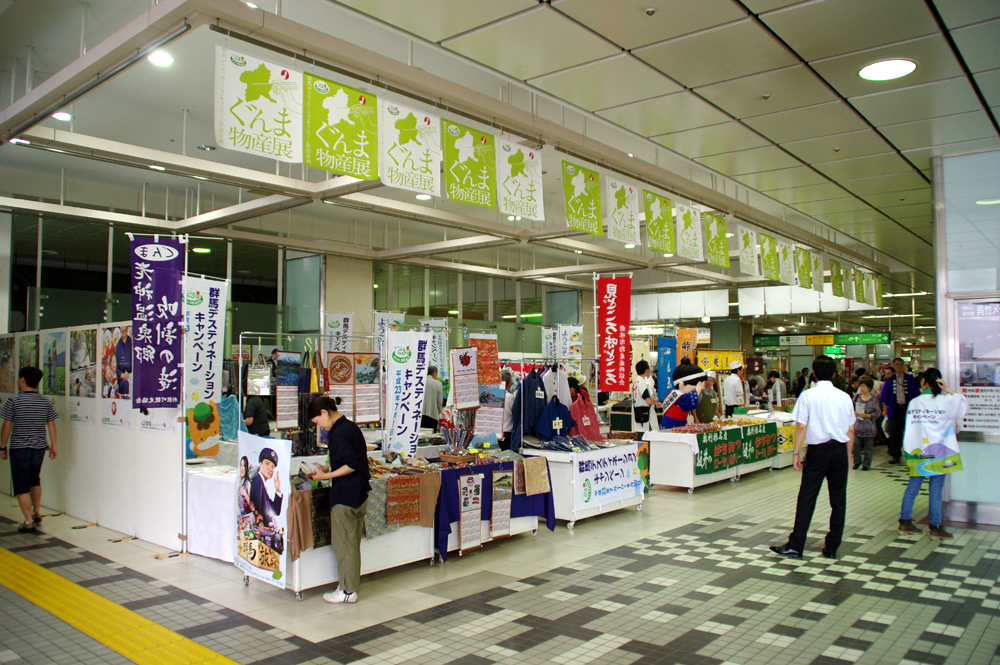
An antenna shop selling local specialties in a railway station in the Tokyo metropolitan area. Railway companies are collaborating with local governments to collect funds for faster recovery of the devastated areas.

Thursday, February 16, 2012

No. 18: Japanese nursery companies strengthen their efforts to develop foreign markets (February 17, 2012)

Business trend
Japanese leading nursery companies are strengthening their efforts substantially to develop the market in Central and West Asian. Sakata Seed will establish a local company in Turkey coming April to market such seeds as tomato, watermelon, and cabbage to local producers directly or through local companies. All the seeds the company tries to market are F1 seeds that allow for uniform growth and stable yields. Because F1 seeds are for one generation only, continuous demand for long periods can be expected. F1 is higher in price than true bred, but its ability to realize high productivity will surely benefit local producers.

The company is now active in Serbia and Uzbekistan, and will set up a local base in Ukraine within the year to market cabbage and broccoli seeds characterized by excellent storage quality in Ukraine and its neighboring countries. It plans to increase sales in Central Asia, East Europe, and Russia to 1,200 million yen in 2015. Takii, another leading nursery company, is also exerting energy to develop the market in the Middle East and Africa. Tokita Seed, in which Kirin Holdings invested, has been active in India that produces seven times more vegetables than Japan for the past 10 years and enjoying a big share in carrot seeds.

Japanese annual vegetable production is about 13 million tons. The Japanese seed market will not grow as it did before because of decreasing population and aging society. In addition, the competition with such large companies as Monsanto is intensifying. Developing foreign markets is the best strategy alternative for nursery companies. Surely, offense is the best defense.  

Saturday, December 31, 2011

No. 17: Secret of the continued success of Yamato Transport (January 1, 2012)

Yamato Transport is the pioneer and all-time leader of the home delivery business in Japan with a share of 42.0%. When you look into Yamato’s activities, you will learn that constant and strenuous efforts alone to develop and expand the market allow a company to maintain the market leader position. Yamato started the home delivery service in 1976 and delivered 1.7 million packages in the same year, and it is supposedly to have delivered 1,400 million packages in 2011. 

After the March 11 disaster, Yamato established a system to save 10 yen from each package for a subsidy to purchase equipment and instruments necessary for fish processing in the devastated area. The company contributed more than 13 billion yen. Although it is clear that it will result in net loss in the current business year, it gave the highest priority to the reconstruction of the local industry. In another prefecture, it introduced an even faster delivery system in alliance with a local supermarket chain. An order the supermarket chain receives from a customer by 4:00 p.m. through its website is delivered to the customer the next day wherever he lives inside the prefecture. 

Yamato places the highest importance on listening to the opinions in the field. A total 55,000 deliverymen and staff members in the operation centers create ideas for new service under the company concept, “We not only deliver packages but also create customer satisfaction.” In another prefecture, Yamato established a system to receive malfunctioning home appliances, fix them, and return them to the customers in just three days in the fastest case. The company is developing repairmen to shorten the delivery time and reduce repair cost. This business now handles more than 10,000 home appliances per month.

Yamato is also energetically expanding the business overseas. Unlike western home delivery companies that entrust local partners with details of local operations, Yamato instills the Yamato way into the mindset of local people. A Chinese deliveryman cannot understand why he has to say “Thank you” to the recipient to whom he delivers a package. However, these kinds of people are now reportedly willing to say, “Thank you!” to the recipients.

The development of the home delivery business goes hand-in-hand with the development of information technology. Yamato never loosens it hold on applying IT to the business development. In Tokyo, it now can deliver an order to a customer inside Tokyo in just four hours in the fastest case thanks to its self-developed See-T Navi. The system enables a customer to take delivery of an order that he places midnight through TV mail-order program early next morning. The company is on the way to expand this system in other metropolitan areas.

The Yamato case tells us how important it is to make constant and strenuous efforts to segmentalize the market and create and develop customers in the well-established business domain.

Wednesday, December 28, 2011

No. 16: Magazine market is shrinking consistently (December 29, 2011)

The magazine market will supposedly decrease to less than 1,000 billion yen in 2011 for the first time in 27 years. The annual sales are estimated to decrease 6-7% from the previous year to 985 billion yen in 2011. Annual magazine sales increased continuously after 1951 when the statistics began to be released and peaked at 1,565 billion yen in 1997. Subsequently, however, sales decreased 13 years in a row mostly because of the spread of the Internet.

The number of titles decreased to 3,453 in 2010 after it peaked at 3,652 in 2006. About 160 titles including information magazines and fashion magazines will be suspended or discontinued in 2011. A leading book dealer told, “With the spread of smartphones, the means that people use to get information are undergoing a radical change.” Although the decreased sales can partly be attributable to the distribution channels damaged by the East Japan Great Earthquake in March, smartphones are surely replacing magazines as a means to collect information among consumers. Book sales are expected to remain almost the same at 820 billion yen in 2011, making the total market of magazines and books decrease 4% from the previous year to 1,805 billion yen.

Wednesday, December 21, 2011

No. 15: Fanuc doubles the production capacity of multijoint welding robots (December 22, 2011)

Fanuc started the operation of its new plant in Yamanashi Prefecture on December 20. With the new plant, the company doubled its production capacity of multijoint welding robots for vehicles production to 5,000 units per month. Thanks to the expansion, it can satisfy more than 40% of worldwide demand for multijoint welding robots. As a company policy, it does not plan to build a plant in a foreign country even in the current high yen period.

The president proudly proclaimed the ability of his company to overcome the current high yen period by enhancing the automation of production process. In fact, Fanuc has characteristically a higher in-house production ration than its competitors. The constant efforts to reduce production cost allow it to stay in Japan. The proximity between the R&D division and the production site is also a big factor because it increased the speed of product development. And the concentrated production also affects its results favorably. Fanuc recorded the highest consolidated net profit in its history for the half-year period between April and September 2011, besides maintaining the operating profit of higher than 40%.

Its rival, Yasukawa Electric, made an announcement to consider the production in China and other Asian countries as the first company to reveal the plan of overseas production. The world market of industrial robot is expected to increase 20% from about 140,000 units in 2011 to about 170,000 units because of the demand increase in China. As the market grows, the competition will intensify and the strategy on production site will become critical.        

Monday, December 19, 2011

No. 14: Who said opticians are only for myopic and hyperopic people? (December 20, 2011)

With the spread of the Internet, it is growing rather hard to quantify consumer behaviors precisely. Market research is no longer a mighty tool. Hunch and instinct are dangerous tools. However hard you may try to know in advance how much your product will be accepted by the market, no consumers can realize how wonderful your product is before they see and touch it.

JINS, an optician chain that focuses on low-priced eyewear, doubled its sales over the level in two years ago to about 15 billion yen. Given the fact that the current eyewear market shrank 30% from the peak, the results of this optician chain are rather striking. The president asked himself, “Is an optician for only myopic and hyperopic people?” He launched eyewear that blocks off blue light coming from the PC monitor supposed to deteriorate the function of the retina. He further prepared several kinds of unmagnified eyewear depending on playing scene for golfers. More than 10% of the visitors of this optician chain are neither myopic nor hyperopic.

He asked himself again, “Why does the price of eyewear depend on magnification, even though the price of shirts does not vary with body size?” In this optician chain, the price of eyewear does not vary with magnification. It varies only with the lens quality. These ideas let the chain grow business rapidly. For your information, the president is neither myopic nor hyperopic. Headquarters of this chain does not hold a regular meeting. Staff members get together and hold a meeting whenever they come across an interesting idea and discuss what they should do to create something new.

Consumers are naturally capricious. For example, McDonald's launched a hearty hamburger named Quarter Ponder despite the current health-conscious trend. It sells fast, while the hamburger it launched following the Korean boom did not sell as fast as the company predicted beforehand. What is important now seems to be an organization and company climate to create something new that surprises consumers.